
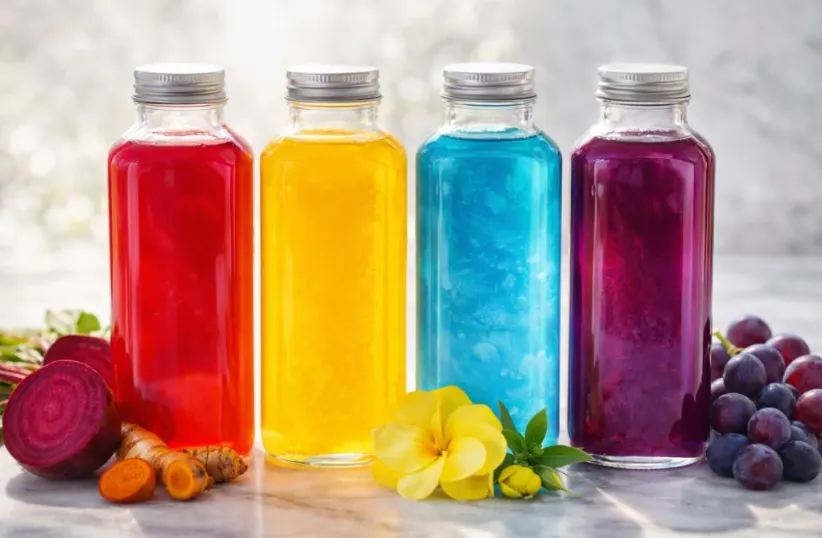
Launching a new product line often requires a diverse palette: a vibrant red for a beverage, a stable yellow for a gummy, and a specific blue for a frosting. While it is easy to find a natural food color supplier specialized in grape extracts, asking them for a yellow frequently leads to hesitation. They might offer a third-party product or simply say no.
This is a common headache in the food industry. Sourcing wholesale natural colors is rarely a one-stop-shop experience when dealing directly with single-source manufacturers. It isn’t because they lack skill; it is because biology and chemistry draw hard lines in the sand. Unlike synthetic colors, which are chemically synthesized from petroleum products like coal tar to create any shade you want, natural pigments are bound by the specific raw materials from which they are extracted.
The Reality of Extraction: Origins Matter
The primary reason you won’t find one factory producing every color lies in the diversity of the source material. A facility designed to crush roots is useless for fermenting bacteria. To get a full spectrum of colors, you are effectively asking for three different industries under one roof: agriculture, animal husbandry, and microbiology.
Plant-Based vs. Microbial Sources
Consider the raw materials. Natural pigments come from plants, animals, and microorganisms.
- Plants:You get Red from chili peppers, Yellow from turmeric, Blue from gardenia, and Green from chlorophyll.
- Microorganisms:Red yeast rice (Monascus) produces a distinct red through fermentation.
- Insects:Cochineal carmine provides that classic vibrant red.
A factory set up to process Anthocyanins from black goji berries, mulberries, or grape skins is essentially a fruit processing plant. They deal with seasonality and crop yields. Compare that to a facility producing Gardenia Yellow, which might use direct extraction, versus Gardenia Blue or Red, which often requires biological fermentation or enzymatic methods. These are fundamentally different biological processes requiring different specialized equipment.
The Manufacturing Gap: Why One Line Can’t Do It All
Even if a supplier could source all the raw ingredients, the machinery required to extract the pigment varies wildly. It is not just about “squeezing” the color out. The stability, purity, and form (powder vs. liquid) dictate the engineering of the production line.
Water-Soluble Powder Processing
Let’s look at the complexity of making a high-quality Beet Red Powder. It isn’t simple. The process involves washing the raw material with tap water, smashing it, extracting it, filtering, conducting adsorption and desorption (often using alcohol), concentrating the liquid, and finally spray drying it into a powder.
This entire line is built for water-soluble extraction. If you try to run a different material that requires an oil-based solvent or supercritical CO2 extraction through this same line, you will fail. The equipment for water washing and spray drying cannot handle the volatile solvents used for other pigment types.
The Challenge of Oil-Soluble Conversion
Things get trickier when you need Oil-soluble colors for chocolate or heavy cream applications. Most natural pigments, like those from gardenia or fruit juices, start as water-soluble.
To get an oil-soluble product from a water-soluble source, you can’t just mix it with oil. It separates. You need a specific Emulsification process. This involves pre-treatment, primary emulsification, secondary emulsification, and homogenization using high-speed shear machines and high-pressure homogenizers. A factory dedicated to simple water extraction rarely invests in this expensive homogenization equipment. This is why you often see suppliers offering “Water Soluble Powder” but looking blank when you ask for an oil-dispersible version for your cocoa butter.
The Technical Challenge: Anthocyanin Stability and pH Sensitivity
Beyond the machinery, there is the chemistry application. A manufacturer might be great at extracting a pigment, but do they know how it behaves in your specific beverage? This is where many direct-from-factory relationships struggle—they sell you a product, not a formulation solution.
Why Your Red Drink Turns Blue
Let’s say you are buying Grape Skin Red (an anthocyanin). You add it to a sports drink, and it looks great. Then you add it to a neutral pH milk drink, and it turns an unappealing blue.
This happens because Anthocyanin stability is heavily dependent on pH. These pigments turn red in acid but shift to blue in alkaline environments. They are also sensitive to light, heat, and metal ions. A single-category manufacturer might sell you the powder, but they might not warn you that their specific batch of Purple Sweet Potato color will fade if your product’s shelf life exceeds six months in clear packaging. You need a partner who understands that Gardenia Yellow is sensitive to light but heat stable, while Beet Red might degrade at high baking temperatures.
The Sourcing Dilemma: Specialist Factories vs. Comprehensive Solutions
So, you are left with a choice. You can try to build relationships with ten different factories—one for your Lutein (Marigold extract), one for your Gardenia Blue, and another for your Grape Skin Red. Or, you can find a partner who bridges these gaps.
Most manufacturers only make what is local to them or what their equipment allows. As noted in industry data, factories split their focus based on market conditions: doing anthocyanins separately from curcumin or gardenia. For a buyer, this means multiple audits, multiple shipping contracts, and fragmented technical support.
Why YAYANG Is Your Best Strategic Partner
This is where YAYANG changes the dynamic for your supply chain. We don’t just move boxes; we integrate the capabilities of the best specialized producers into one cohesive portfolio. Because we understand that no single factory can effectively produce Beet Red, Gardenia Blue, and Lutein under one roof with high efficiency, we have done the heavy lifting of vetting and integrating these distinct supply lines for you.
When you work with YAYANG, you get more than just a bag of powder. You get tech safety. We make sure every batch meets strict rule standards, such as GB 2760-2014, and fits world checks like ISO, HACCP, KOSHER, and HALAL. We give the key papers you need, including TDS (Technical Data Sheets) and COAs (Certificates of Analysis), proving that heavy metals like Lead and Arsenic are tightly controlled (≤2 mg/kg).
Whether you need a heat-steady red for a bakery use, an acid-steady purple for a drink, or a custom oil-mixing blend for chocolates, we check things like pH, light fight, and air risk to suggest the exact right detail. You stop guessing and start putting out products.
Conclusion: Simplify Your Supply Chain
Finding the right natural color should not become a big mess in moving stuff. While single factories do well at certain pull-outs—whether it is growing Red Yeast Rice or pressing grapes—no one spot can handle every living source. The science of keeping a drink red is just different from the rules of making chocolate yellow.
Instead of handling many checks and risking mix fails with wrong items, you can make your whole process easier by picking a helper who sees the full view. At YAYANG, we mix wide market reach with the tech smarts to make sure your products stay steady and follow rules. Don’t let supply holes slow your start. Stop putting your product’s steadiness at risk with mismatched items. Reach out to our tech team for a talk on mix fit, or ask for a sample to check the color yourself.
FAQ
Q1: Why are natural colors more expensive than synthetic ones?
A: Natural colors need hard pulling out from true plants or living things. For example, they come from picking lots of grapes or growing chili peppers. This depends on weather and times of year. But fake ones are made cheap in big groups from stuff like coal tar.
Q2: What is the typical shelf life of these natural pigments?
A: In most cases, powders and liquids hold up for about 12 to 24 months. You must store them right, like sealed up, in a cool spot, and away from light. Yet some liquid types might last only 6 months.
Q3: Can I use Grape Skin Red in a neutral pH baking recipe?
A: Take care with this. Grape Skin Red is an anthocyanin. So it could change shade from red to blue or purple if the dough lacks acid. It works best in drinks with acid.
Q4: Do you have a minimum order quantity (MOQ) for testing?
A: Yes, we aim to bend a bit for R&D tests. Our usual packs are 1kg/bag or 25kg/carton. So the MOQ often begins at only 1kg.
Q5: My product contains oil; can I use a standard water-soluble powder?
A: No, it will not blend nicely. And it might seem spotty. You need an oil-soluble or spread-out mix made by emulsification. This makes sure the color mixes smooth into fats.