A six-color marker set may look simple. For an importer, it contains an ink formula, food-contact parts, packaging, and claims that must fit the destination market. So, are edible ink markers food safe? Natural edible ink markers can be food safe when each ingredient is permitted for the intended use, the contact parts have suitable evidence, and the finished lot meets specification.
The word natural describes an ingredient source or product position. Your approval decision still rests on legal color identities, use limits, production controls, labeling, testing, and traceability. One certificate cannot answer all those questions.
What Makes Natural Edible Ink Markers Food Safe?
Start with the product that will reach the customer. A facility certificate may support the review, yet your file needs to connect the exact formula and marker components to the exact SKU. That connection matters when a customer writes on a cookie and then eats the decorated surface.
Formula and Food-Contact Parts
Ask for the legal name, function, and concentration or use level of each colorant, carrier, humectant, preservative, and acidity regulator. A plant source alone does not establish permission for food use. Each substance needs a legal basis in the country where you will sell the marker.
Ink passes through the nib and reservoir before touching food. Request their material composition, suitability statement, and migration data when the material, contact pattern, or local rule calls for testing. Food-safe edible markers are complete products, so a compliant ink formula covers one part of the review.
Intended Use and Lot Control
Define the surfaces, directions, expected ink transfer, consumer group, and sales channel. Dry royal icing and firm fondant take marker strokes well. Macaron shells need light pressure, while wafer paper needs a blotted nib and short strokes because excess liquid can curl the sheet. These small details belong in use guidance.
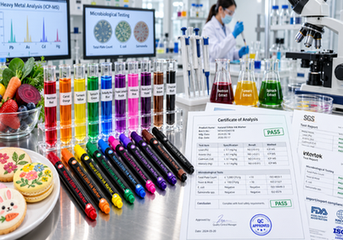
Link every shipment to a lot code and release record. The certificate of analysis should name the product, batch, test method, result, unit, and specification. A generic report tells you about one submitted sample. A lot-specific record tells you what the factory released for your order.
Which Certificates and Records Should You Request?
Edible ink marker certification is a broad search phrase, though each record has a narrow job. A food-safety management certificate covers a named site and scope. A dietary certificate covers listed products and dates. A laboratory report covers the sample identified on the report. Read each one that way.
Site and Product Records
Request a current food-safety certificate or audit summary, a hazard-control plan summary, and details for sanitation, allergen control, and lot release. Match the company name, site, scope, dates, and certificate status.
Your edible marker supplier documents should also include the full ingredient statement, allergen assessment, product specification, shelf-life support, food-contact declarations, label artwork, storage guidance, traceability procedure, recall process, and change-notification terms. Kosher, Halal, vegan, organic, and allergen claims need records that cover the exact SKU and manufacturing site.
Risk-Based Testing
Build the test panel from the formula and process. Common checks cover identity, microbiological limits, relevant heavy metals, preservatives, color specifications, leakage, cap seal, and shelf-life performance. Use an accredited laboratory when required. Keep the tested sample identity beside the commercial SKU; similar color names get messy during a busy launch.
How Do Import Rules Change by Market?
Edible marker import requirements follow the destination country. Review the formula and artwork for each market before printing retail packs. A color permitted in one place may carry another name, use condition, or restriction elsewhere.
United States Review
For the United States, match each color additive to the applicable listing, permitted uses, restrictions, and specifications. Colors exempt from batch certification still need to meet those conditions. Review the legal basis for carriers, humectants, preservatives, and other ingredients as well.
The importer file may also need foreign food-facility registration details, prior-notice procedures, and Foreign Supplier Verification Program records. Your responsible party should document the hazard review, supplier evaluation, verification activity, corrective actions, and recordkeeping.
Label review covers the product name, net quantity, ingredients, color declaration, allergens when applicable, responsible company details, lot code, directions, and storage.
Country-Specific Formula and Artwork
For the European Union, Great Britain, and Canada, complete a separate food coloring compliance review. Check authorized colors, food categories, use levels, additive specifications, ingredient naming, language, allergen information, and importer or responsible-party details.
Canada also requires bilingual mandatory information in common retail settings. Regulatory lists change, so record the source and review date in the approval file.
How Should You Qualify a Supplier and Sample?
Put the market, food surfaces, color set, tip format, pack style, claims, and volume in the RFQ. This gives both sides one product definition and keeps an approved sample from quietly becoming a different retail set six months later.
Document and Change Review
For wholesale edible ink markers, compare the formula version, manufacturing site, nib material, packaging, label, shelf life, and lot format across the quotation, sample, purchase order, and shipping papers.
Set written notification rules for changes to ingredients, suppliers, site, components, and artwork. Place a shipment on hold when a certificate has expired, a test report lacks a batch number, or the delivered label differs from the approved file.
Production-Representative Surface Trial
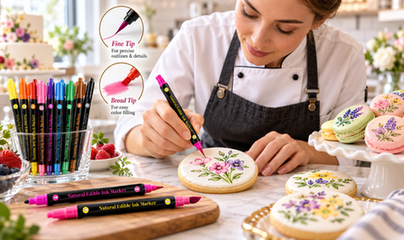
Test production-representative samples on your actual recipes. Make three strokes on a spare piece and check line width, color density, odor, taste, drying time, and transfer after packing. Use the fine tip for names and outlines and the broad tip for compact fills. Run the test on dry royal icing, firm fondant, macaron shells, chocolate plaques, and wafer paper when those surfaces appear in your customers’ work.
How Can a Document-Ready Supply Plan Reduce Import Risk?
Once the file is complete, product handling becomes the next practical check. YAYANG’s natural edible ink marker uses a fine tip for lettering and outlines plus a broad tip for compact color areas. That format supports the surface trials described above and lets your team assess one marker across several bakery applications.
Use the food product range to identify the color set and pack format for review. Then ask YAYANG for the current ingredient details, allergen statement, shelf life, storage guidance, available compliance records, lot format, samples, labeling options, carton data, and MOQ. Send the destination market and intended surfaces with the request. The YAYANG website provides the contact route for that product and document discussion. Approve the sample and paperwork as one package.
FAQ
Q1: Are Natural Edible Ink Markers Food Safe?
A: They can be food safe when the formula is permitted for the intended use and market, food-contact parts have suitable evidence, production follows documented controls, and the shipped lot meets specification.
Q2: What Makes Food-Safe Edible Markers Different from Craft Markers?
A: Food-use markers need permitted ingredients, suitable contact materials, food labeling, controlled production, and lot traceability. Craft markers are made for nonfood surfaces and should stay away from food.
Q3: Is One Edible Ink Marker Certification Enough for Import Approval?
A: No. Review site controls, formula authorization, food-contact evidence, product tests, artwork, claims, and batch records. Each document answers a separate approval question.
Q4: Who Should Check Food Coloring Compliance?
A: Your importer or regulatory reviewer should match every color and other ingredient to current rules in the destination market and record the source, date, and approved use.
Q5: What Should You Test Before Buying Wholesale Edible Ink Markers?
A: Test line width, color density, drying, taste, odor, leakage, cap seal, and packing transfer on your real food surfaces. Match the approved sample to the formula, label, shelf life, MOQ, and lot records.