
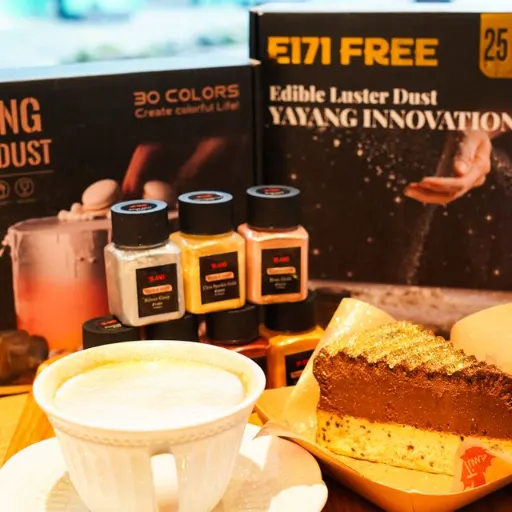
Introduction
The ban on E171 (Titanium Dioxide) in the EU has created a massive headache for the food industry. For decades, manufacturers relied on E171 as the ultimate whitening and opacifying agent. It was the “base coat” that made colors pop and hid the dark surface of chocolate or baked goods.
Now, R&D managers face a tough reality. Most natural alternatives on the market are too transparent. When you put them on dark chocolate or a cookie, the back shows. The outcome? A dim, dirty shade instead of a bright metal end.
But you do not have to give up looks for rules. By getting particle rules and picking the correct base stuff, you can find a full set of natural food colorants that match the work of the old man-made choices.
Why E171 Was King (and Why Replacements Fail)
To solve the problem, we first need to know why E171 was so good. It comes down to a property called the “Refractive Index.” This measures how much a material bends light.
Titanium Dioxide has a massive refractive index of about 2.61. This is incredibly high. It acts like a perfect mirror, bouncing back almost all light that hits it. This creates a solid, opaque wall of white.
Most common replacements, like rice starch or calcium carbonate, have a refractive index of only around 1.5 to 1.6. That is a huge drop. They don’t bend light enough to block the view. They act more like clear glass than a mirror. If you try to make a Gold Confectionery Coating using these simple substitutes, the finish will look weak. It often ends up looking like plastic rather than polished metal. You simply cannot fix this by adding more powder; you need a material that interacts with light differently.
Key Factors for High-Coverage in Natural Pigments
So, how do we get that solid cover without the titanium? It comes down to three technical factors.
- The Base Material: Natural vs. Synthetic MicaThe core of any luster dust is mica. For Edible Metallic Finishes, the quality of this mica matters. Low-grade natural mica has impurities that scatter light, making the powder look gray. Premium natural mica is cleaner and brighter.
- Particle Size EngineeringThis is the most critical part for coverage.
- Large particlessparkle a lot but leave gaps (low coverage).
- Small particlescover well but don’t shine much (matte finish). The secret is a “tight distribution curve.” You need a powder that balances fine particles for opacity with medium particles for shine.
- The Coating TechnologySince we can’t use TiO2 to coat the mica, we must use other metal oxides (like Iron Oxide) in a very specific way. Advanced manufacturing uses a multi-layer coating process. By stacking these layers precisely, we create “constructive interference.” This tricks the light into reflecting more strongly, building up the “thickness” of the color without using banned ingredients.
Application Solutions: Wet vs. Dry in Mass Production
Choosing the right Titanium Dioxide Free Food Color is only step one. How you apply it on the production line changes the outcome.
Dosage and Blending Best Practices Switching to natural ingredients is rarely a simple 1-to-1 swap. Natural minerals often have a different density than synthetic ones.
- Loading Rates:Because natural oxides reflect less light than TiO2, R&D teams often need to increase the concentration slightly. We typically recommend starting with a 5% to 10% increase in powder load to match the old opacity levels.
- Pre-dispersion is Key:Natural powders can be harder to wet. Do not just dump dry powder into a large tank of syrup. It might clump or sink. Create a “slurry” or paste first by mixing the dust with a small amount of oil or alcohol. Once smooth, add this concentrate to your main batch.
Spray Coating (For Pan-Coated Goods) If you are coating gum or hard candy, you likely use an alcohol suspension.
- The Challenge:High-opacity dusts are heavier. They settle at the bottom of the tank/nozzle quickly.
- The Fix:Look for “dispersible” luster dusts designed for alcohol. Also, ensure your holding tanks have constant agitation (stirring) to keep the solids suspended.
Enrobing and Dusting (For Chocolate) For chocolates, transparency is the enemy. A thin natural dust will vanish on dark chocolate. You need a High-opacity edible dust specifically formulated with a higher pigment load. This ensures that a single pass through the enrober or dusting curtain provides full coverage, saving you money on raw materials and processing time.
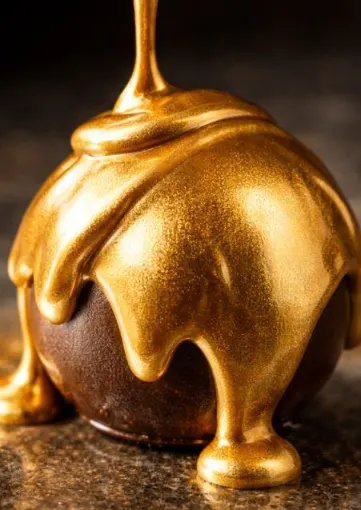
Case Study: Switching to NE100S Series
Let’s look at a real-world solution. Many export-focused brands have successfully switched to the NE100S Gold Series.
This product line was engineered specifically to solve the opacity gap. Instead of relying on titanium dioxide for the “base,” it uses a proprietary layering of naturally derived colorants.
The result is a high-opacity titanium dioxide-free luster dust that passes the “black background test.” Even when applied to dark chocolate, it reflects a solid, intense metallic gold. It allows manufacturers to keep their “premium” look while fully complying with EU Regulation 2022/63.
Conclusion
The transition away from Titanium Dioxide is not just a regulatory hurdle. It is a strict quality check for your entire supply chain. If your current supplier’s “natural” option looks dull or transparent, it is time to look for better technology.
You do not have to choose between strict compliance and a beautiful product. With the right E171-Free Edible Solutions, specifically the YAYANG NE100S Series, you can future-proof your products for the global market. This series proves that clean label ingredients can still deliver the intense, high-coverage metallic finish that customers love.
Global Manufacturing & Compliance Partner
Hangzhou Yayang Industrial Co., Ltd. has been a focused maker of effect pigments since 1999. Set in Hangzhou, China, the spot aims on making top-grade color fixes for the food, pretty, and home make fields.
With more than two ten years of know-how, the work goes past plain raw stuff give. The firm gives full mix help backed by a set research group. Working from a GMP-follow factory, YAYANG holds key world papers, including ISO22000, ISO9001, and KOSHER. This makes sure that every group of shine dust meets tight world safe rules.
FAQ
Q1: Does this E171-free dust affect the viscosity of my coating syrup?
A: Generally, no. The particle size is designed to flow smoothly. However, because it lacks TiO2, you might need to adjust your mixing ratio slightly to achieve the same color density.
Q2: Is it stable in high-heat baking?
A: Yes. Being mineral-based (Mica and Iron Oxides), these pigments are heat stable up to very high temperatures, making them safe for cookies and crackers.
Q3: Can we get custom colors?
A: Yes. While Gold and Silver are standard, custom metallic shades can be developed to match specific brand identities.
Q4: Do these pigments meet specific dietary standards for export?
A: Yes. Our entire range of E171-free edible luster dust is Halal and Kosher certified. This allows you to include them in industrial baking ingredients for diverse global markets without compliance worries.
Q5: Do you sell directly to factories?
A: Absolutely. We are a manufacturer, not a reseller. We provide wholesale edible pigments in bulk options (from 1kg jars to 25kg drums) to ensure your production line never runs dry.
For brands seeking a reliable partner to navigate complex regulations like E171-free compliance, this manufacturer delivers the technical expertise needed to succeed. Before you finalize your next bulk order, request a sample for stability testing to ensure your products meet the highest standards.