
Natural colors frequently shift. This happens during heating, cooling, setting, or storing. Red might seem warmer. Green can turn olive. Meanwhile, blue sometimes looks gray inside an ivory fat base. Selecting natural red, green, and blue oil-based food coloring demands a strict method.
You must evaluate the pigment source, carrier, dose, recipe, and storage setup. These actions ensure stable hues. They stay uniform in chocolate, cocoa butter, fillings, and coatings.
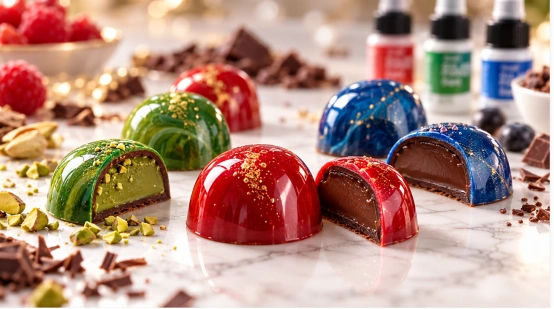
Why Natural Red, Green, and Blue Act Differently
Every pigment source reacts uniquely to heat, light, oxygen, and acidity. The food base’s shade matters too. Always check permitted uses and label laws. Lastly, verify the carrier, dosage limits, and storage tips before approving any color.
| Color | Sources to investigate | Variables to test |
| Red | Beet, paprika, anthocyanin, or permitted carmine | Heat, pH, light, base color |
| Green | Chlorophyll-based color or an approved blend | Heat, light, acidity, oxidation |
| Blue | Spirulina-derived blue or another permitted source | Heat, light, acidity, holding time |
How to Choose Natural Red Oil-Based Food Coloring?
The target shade and base color determine the choice of natural red oil-based food coloring. White chocolate and fat-based icing carry an ivory tone, so a cool red can appear warmer after mixing.
Match the Red Source to the Process
An oil-soluble red food coloring may be a pigment in an oil-compatible carrier or a fine fat dispersion. Check whether the product needs agitation and whether settling can occur. When evaluating natural red food coloring for chocolate, record the melted shade and the fully set shade. Check viscosity, gloss, flavor, snap, and migration into nearby layers. Deep red often needs a higher dose than pink, so stay within the supplier’s guidance.
How to Choose Natural Green Oil-Based Food Coloring?
Yellow and blue tones determine the appearance of green. A natural green oil-based food coloring may use one source or a blend, and the blend components can change at different rates during storage.
Define the Green Shade Before Sampling
Set a reference such as mint, leaf, lime, forest, or olive. An oil-soluble green food coloring can look bright in clear cocoa butter and softer in opaque white chocolate. Evaluate natural green food coloring for chocolate under fixed lighting after the same setting time. Include flavors, acids, inclusions, and emulsifiers in the trial because they can affect dispersion.
How to Choose Natural Blue Oil-Based Food Coloring?
Many natural blue sources have limited tolerance for heat or acidic conditions. A natural blue oil-based food coloring should be tested at the actual line temperature and holding time.
Test Blue in the Complete Formula
An oil-soluble blue food coloring can appear greenish in an ivory base because the base adds yellow. A whiter base changes the visual result. For natural blue food coloring for chocolate, prepare low, middle, and high doses. Check the samples after setting and storage, recording changes caused by light, heat, oxygen, packaging, or contact with other layers.
How to Keep Food Coloring Consistent?
Anyone asking how to keep food coloring consistent needs a written specification and a repeatable comparison method. Lighting, sample thickness, background, and observer judgment can change a visual decision.
Set a Measurable Standard
Keep an approved physical sample or define instrument readings with a tolerance. Use the same base formula, sample thickness, cooling conditions, light, and evaluation time. This supports food color batch consistency across lots and production runs.
Track Natural Color Stability
Record the color lot, pigment concentration, carrier, dose by weight, base fat, mixing temperature, heating profile, packaging, and storage time. These records show natural food color stability in the finished food. Repeat the trial when a recipe, process, package, or supplier lot changes.
Test Each Fat-Based Application
Test every intended fat system before approval. Cocoa butter, real chocolate, compound coating, bakery fat, and oil-based filling differ in opacity, viscosity, composition, and processing temperature.
Coloring White Chocolate
When coloring white chocolate, keep tools dry, bring sealed color to room temperature when condensation is possible, and weigh each addition. Mix until even, then check temper, set, gloss, snap, and mold release.
Coloring Cocoa Butter
When coloring cocoa butter, test at the spraying, brushing, or molding temperature. Confirm particle-size and filter guidance if the color will pass through spray equipment. Compare thin and thick layers because layer depth changes perceived shade.
Coloring Compound Coating
An oil-based food coloring for compound coating should be checked in each coating formula. Fat type, milk solids, emulsifiers, and base color can change the required dose and final appearance.
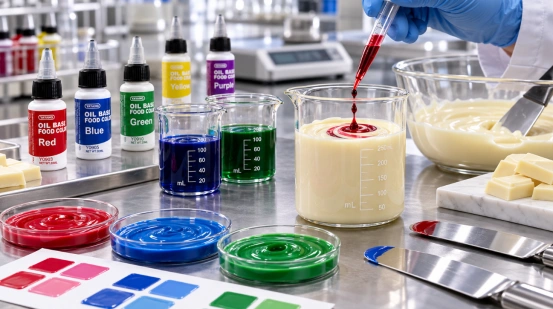
A Practical Bench Test
Prepare an uncolored control and three measured color doses. Keep the base batch, temperature, mixing time, and sample weight constant. Record warm viscosity, set shade, gloss, texture, flavor, and release. Store samples in the intended package under normal conditions, then repeat the approved dose with another color lot when possible. Retain the formula, lot number, photographs, and approval result.
What to Ask a Natural Food Coloring Supplier?
A natural food coloring supplier needs the product type, fat system, target shade, processing temperature, storage conditions, destination market, and expected shelf life.
For bulk oil-based food coloring, request the ingredient statement, color source, carrier, dosage range, mixing instructions, heat and light guidance, regulatory documents, pack size, shelf life, lot coding, minimum order quantity, and certificate of analysis. A complete food coloring sample request should include the base material and a physical or numerical color target. Review YAYANG‘s food ingredient range and submit application details through a technical sample request.
Build the Specification Around the Finished Product
Approve the color in the final food, process, package, and storage period. Document the accepted dose, process range, set shade, storage result, and incoming-lot check. This gives purchasing, development, quality, and production teams one reference for future batches.
FAQ
Why does natural food coloring change color?
Heat, light, oxygen, acidity, base color, and storage time can change a natural pigment. Test the complete formula and package to measure the shift.
How much oil-based food coloring should I use?
Start within the supplier’s recommended range and prepare several measured doses. Pigment strength, target shade, base opacity, process, flavor limits, and regulations determine the suitable amount.
Can oil-based food coloring be used in chocolate?
Yes, when the color is designed or confirmed for fat-based applications. Test it in the exact chocolate or coating for dispersion, viscosity, temper, set, flavor, and storage stability.
Can One Dose Work in Every Product?
Each base needs its own dose trial. Cocoa butter, white chocolate, compound coating, and fat-based fillings can produce different shades from the same color.
How Should Incoming Color Lots Be Checked?
Prepare a standard sample with a fixed base, dose, temperature, mixing time, and thickness. Compare it with the approved standard under controlled lighting and record the result.