
If you have ever asked is luster dust edible, the real answer is: some products are safe. Others are not. The jar might look like a standard baking item. It may sit near sprinkles and food coloring. That still does not prove it belongs on food.
Real edible luster dust is meant for eating. Therefore, it should display a direct food-use statement. It also needs an ingredient list. By contrast, non-toxic luster dust fits crafts or removable decorations. However, “non-toxic” does not mean you can eat it.
Items marked for decorative use only should not touch frosting, chocolate, or cookies. Do not apply them to surfaces guests will eat. The label matters more than visual shine. Gold powder looks identical under bakery lights. Yet, the actual contents vary wildly.
Is Luster Dust Edible?
Whether you can eat a decorating powder relies on its production. It also depends on the labeling and intended purpose. Names like luster dust, pearl dust, shimmer powder, and sparkle dust are not official guarantees of food safety.
Some Products Are Made for Food
Edible cake decorating dust must clearly state it is edible. It can say food grade or meant for direct food use. The packaging needs an ingredients list. Typical components in edible glitter and dust include sugar, gum arabic, maltodextrin, and cornstarch. Approved food color additives and permitted mica-based pearlescent pigments are standard.
Federal FDA luster dust guidance advises home and commercial bakers not to use glitter or dust on food unless it is specifically manufactured to be edible. The guidance also says that edible products should list their ingredients, while products that only say “non-toxic” or “for decorative purposes only” should not be applied directly to food.
So, can you eat luster dust? Yes, but only when the specific product is clearly sold as edible and its label supports that claim.
Decorative Products Are Different
Decorative luster dust may be designed for cake toppers, display pieces, flower wires, or craft projects. A bottle placed in a cake-decorating aisle can still be non-edible luster dust.
If the package says remove before eating, treat that as a firm instruction. The powder should not remain on buttercream, fondant, chocolate, cake pops, or drinks when served.
What Is the Difference Between Edible and Non-Toxic Luster Dust?
The difference between edible vs non-toxic luster dust is not a minor wording issue. “Edible” describes a product made with ingredients intended for consumption. “Non-toxic” usually means the product is not expected to cause poisoning under certain exposure conditions. It does not turn a craft pigment into food.
Does Non-Toxic Mean Edible?
No. If you are asking does non-toxic mean edible, remember that a safety statement for accidental contact is not the same as permission to swallow a product.
This distinction has caused real harm. Public health investigations during 2018 and 2019 linked cakes decorated with certain dust products to heavy-metal poisoning cases. The products involved were found to contain high levels of copper, lead, or other metals. Several affected children were between 1 and 11 years old. The report stated plainly that a “nontoxic” label does not show that a product is safe for consumption.
That sounds dramatic, but it makes the buying rule quite simple: never rely on the words “non-toxic” alone.
What Does “For Decorative Use Only” Mean?
A for decorative use only statement means the product is not sold as an edible ingredient. You may use it on a decoration that can be removed completely before serving, provided loose powder cannot fall onto the food.
That is harder than it sounds. Fine pigment travels. A little puff from a brush can settle on frosting several inches away, which is why food businesses usually find it safer to keep edible and craft materials in separate work areas.
How Can You Tell If Luster Dust Is Edible?
To learn how to tell if luster dust is edible, check the package before you check the color chart. A reliable luster dust label should give you enough information to identify the product, its contents, and its intended use.
Check the Food-Use Statement
Look for clear wording such as:
- Edible
- Food grade
- Intended for food use
- Suitable for direct application to food
Do not assume that “cake decorating powder” means food-safe luster dust. It describes an application, not necessarily an edible product.
Read the Ingredient List
Review the luster dust ingredients in full. Proper edible luster dust ingredients should be named rather than hidden behind vague terms such as “mineral powder” or “metallic color.”
Check whether the listed food color additives are permitted for the intended use in your sales market. A substance allowed in one country or product category may face different limits elsewhere.
Terms such as “natural,” “mineral,” and “mica” also need context. Not every mica pigment is one of the permitted pearlescent pigments for food.
Check Traceability and Dietary Details
A food-grade luster dust package should identify the manufacturer or supplier and preferably include a batch code, net weight, storage instructions, and shelf-life information.
For commercial orders, request a luster dust ingredient specification, a luster dust allergen statement, and a batch-related luster dust certificate of analysis when available. Also review claims such as vegan edible luster dust, allergen-free edible luster dust, or taste-free formulation against the supporting documents.
Does E171-Free Mean the Product Is Edible?
An E171-free claim tells you that a product does not contain titanium dioxide identified as E171. It does not replace an edible statement or full ingredient list.
Check More Than One Claim
An E171-free edible luster dust should still be assessed as a complete food product. Check the intended use, ingredients, allergens, manufacturing details, and applicable market requirements. The same applies to any titanium dioxide-free luster dust.
In other words, “free from” information is useful, but it answers only one question.
Can You Use Non-Edible Dust on Removable Decorations?
You may use a non-food product on a completely removable decoration, but it should not touch edible surfaces or shed powder onto them. This is where theory meets a busy Saturday order, and things can get messy fast.
Keep Food and Craft Materials Separate
Use different brushes, containers, trays, and storage areas. Do not pour unidentified powder into an unmarked jar. Once the original label is lost, staff can no longer verify cake decorating dust safety.
For a child’s birthday cake, a dessert buffet, or a chocolate display where guests may eat every part, choose food-safe cake decorating dust from the start.
What Should Commercial Bakers Check Before Buying?
Commercial buyers carry extra responsibility because one jar may be used across dozens or hundreds of products. Before choosing a food-grade luster dust supplier, review the product’s market suitability and documentation.
Ask Practical Supplier Questions
Confirm:
- Is the powder manufactured for direct food use?
- Is the complete ingredient list available?
- Which markets and applications does it cover?
- Can the supplier trace individual batches?
- Are custom labels checked for correct food-use wording?
Buyers searching for FDA approved luster dust should be careful with that phrase. A better approach is to check whether the ingredients and labeling meet the rules that apply to the intended food use.
Why Consider YAYANG for Edible Decorating Dust?
When appearance and safety both matter, a supplier should offer more than an attractive shade card. YAYANG has produced effect pigments since 1999 and supplies food-grade, cosmetic, DIY, and industrial pigment ranges. Its site also describes R&D, quality control, design support, packaging services, and OEM or ODM capabilities.
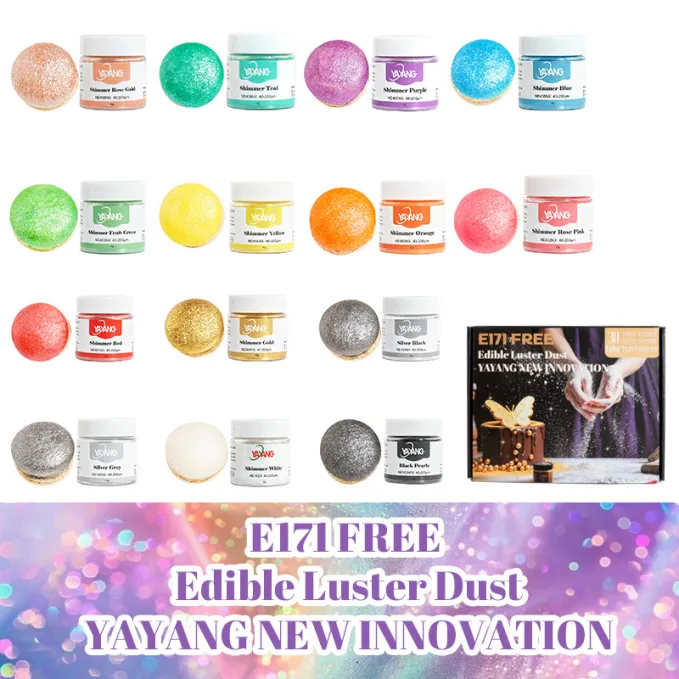
For food decoration, YAYANG offers E171-free edible luster dust described as food grade, titanium dioxide free, vegan friendly, common allergen free, and without flavor impact. The range covers metallic, pearl, and vivid colors for cakes, cookies, cupcakes, chocolate, and beverages. Buyers seeking an edible luster dust supplier, wholesale edible luster dust, or custom edible luster dust can also discuss color, packaging, and order-size needs.
FAQ
Q1: Is luster dust edible?
A: Some luster dust is edible, but not every product is. Check for a clear edible or food-grade statement and a complete ingredient list.
Q2: Does non-toxic mean edible?
A: No. “Non-toxic” does not mean a product was made or approved for consumption.
Q3: How can you tell if luster dust is edible?
A: Check the food-use statement, ingredient list, manufacturer details, warnings, batch information, and applicable product documents.
Q4: What does “for decorative use only” mean?
A: It means the dust is not intended to be eaten. Any decorated piece must be removed before the food is served.
Q5: Is E171-free edible luster dust safe to use on cakes?
A: It may be suitable when it is also clearly labeled edible or food grade and includes ingredients approved for the intended cake-decorating use.