Introduction
Launching private label edible ink markers starts with a product file. Add the logo after you define colors, tips, formula, pack size, market, and testing. Natural edible ink markers need a precise natural-claim definition. Ask for color sources, carriers, preservatives when used, allergens, shelf life, and storage before printing.
Use a simple route. Define the customer, choose a small range, select a manufacturing model, approve samples, review labels, inspect production, then scale reordered SKUs.
How Do You Define Your Private Label Brand Strategy?
Your first decision is the customer and decorating job. A cake shop may need fine lettering and repeat colors. A home-baking set may need several colors and a compact pack. An event kit may need a broad tip for quick color blocks.
Set the Product Promise
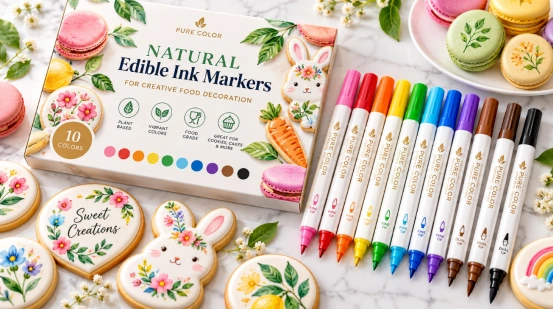
Write down supported surfaces, expected ink transfer, tip widths, color count, pack format, and price band. List dry fondant, fully set royal icing, cookies, macarons, chocolate plaques, or wafer paper after a sample passes each test.
Include custom edible pens in the brief when you need a special barrel, color set, or printed pack.
Define the Natural Claim
Natural should identify a source or formula position that you can document for the destination market. Ask the supplier for legal color names, carrier details, use limits, allergen information, and a version-controlled specification.
Which Product Range Should You Launch First?
A focused range gives you time to test each color, cap, nib, label, and carton. Stock planning also gets easier when one shade sells faster.
Choose Colors and Tip Formats
Start with core colors, then add themed or seasonal sets after the first sales cycle. Compare fine-tip, broad-tip, and dual-tip designs by line control, fill area, cap fit, and customer type. Record ink volume beside each SKU.
Confirm the Edible Ink Marker MOQ
Ask for separate quantities for samples, pilot production, stocked colors, custom colors, and printed packaging. The edible ink marker MOQ can change when you add a new formula, barrel print, carton, or color set. Put the quantity, pack count, and quote date in the purchase file.
Should You Choose OEM or ODM Edible Markers?
The manufacturing model sets your customization level and the supplier’s development work. Put fixed and adjustable items in the quotation so the sample stays connected to production.
OEM Edible Markers
OEM edible markers suit a defined brief. You provide the color targets, ink volume, nib, barrel, cap, pack format, artwork, and inspection limits. This route gives you a detailed specification for a distinct private label food markers range.
ODM Edible Markers
ODM edible markers start with an existing marker platform. You may adjust the colors, logo, artwork, pack count, or label while the core body and filling process stay close to the supplier’s standard. Ask which parts can change and whether new tests apply.
How Do You Qualify an Edible Marker Manufacturer?
Treat supplier review as an evidence check. A sample shows writing performance. Your file still needs the formula, food-contact parts, lot release, and label record for the shipment.
Review the Supplier File
An edible marker manufacturer should provide a product specification, ingredient or color-source statement, allergen assessment, shelf-life support, storage guidance, food-contact information for the nib and reservoir, and lot coding rules. An edible ink pen supplier should explain filling, cap sealing, retained samples, complaint handling, and change control.
For wholesale edible ink markers, compare the factory site, formula version, nib material, packaging, lead time, and MOQ across the quotation, sample, purchase order, and shipping papers. Hold a shipment when a certificate is expired, a batch number is missing, or the delivered label differs from the approved file.
Run a Production-Representative Trial
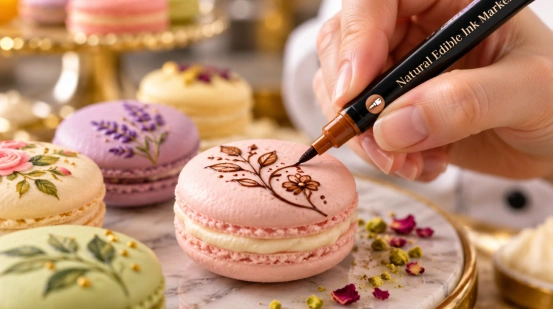
Make three short strokes on the same food surface you sell to customers. Check line width, color density, odor, taste, drying time, leakage, cap seal, and transfer after packing. A fine tip suits names and outlines. A broad tip suits compact fills. Use light pressure on macarons. Blot the nib before wafer paper because excess liquid can curl the sheet.
What Should Food-Safe Marker Packaging Show?
Packaging carries the product promise into a customer’s kitchen. Review the artwork after the formula and intended use are fixed, then check every printed field against the target market.
Build Food-Safe Marker Packaging Around the SKU
Your food-safe marker packaging should carry the product name, net contents, ingredient statement, allergens when relevant, storage, shelf life, lot field, usage directions, supported surfaces, and required business details. Confirm language, warnings, and importer information before printing.
Approve the Physical Pack
Check cap retention, tamper evidence, barcode placement, print legibility, carton quantity, and drop performance. Keep one signed golden sample for the marker, label, and pack. It becomes the reference for future lots.
How Can You Control Quality Before Launch?
Quality control connects the approved brief to the goods in the carton. Use checks before filling, during assembly, and before release.
Set Pre-Production Checks
Match the production order to the signed formula version, color references, artwork, nib specification, packaging bill of materials, and inspection plan. Confirm raw-material lot controls before filling begins.
Inspect During Production and Before Shipment
Check fill volume, ink flow, tip insertion, cap seal, barrel print, lot code, pack count, and carton marks. At final inspection, repeat the surface writing test, review the document pack, and retain a sample from each lot.
How Do You Scale a Private Label Marker Brand?
Start with a controlled first order through your chosen channel. Track sales by color set, complaints, dry or leaking markers, surface performance, returns, and damaged packs. Ask decorators to test the recipes named on the label.
Reorder proven SKUs before adding custom shades or larger packs. Set a reorder point from forecast demand, supplier lead time, safety stock, and remaining shelf life. A missing cap in a carton can create more returns than a weak campaign.
How Can a Technical Partner Support Your Launch?
Once the product brief is fixed, YAYANG can be reviewed for marker format, color development, sample work, packaging, and food-use documentation. Its fine-tip and broad-tip format gives you a basis for lettering and compact fills across fondant, royal icing, cookies, macarons, chocolate plaques, and wafer paper. Test the sample on your recipes.
Use the food product category to identify the relevant color and pack format. Send the target market, surfaces, colors, volume, label language, and packaging idea with your request. Ask for the current ingredient details, allergen statement, shelf life, storage guidance, sample terms, edible ink pen supplier documents, and edible marker manufacturer MOQ. The YAYANG website provides a contact route for that review.
FAQ
Q1: What Are Natural Edible Ink Markers?
A: They are food-use writing markers that use documented color sources and a formula made for the intended decorating application. Review ingredients, food-contact parts, labeling, and lot records for the target market.
Q2: How Do Private Label Food Markers Reach Retail Shelves?
A: Define the customer, approve the marker and pack, confirm the label fields, test the supported surfaces, and release each lot through traceable records.
Q3: What Should You Ask an Edible Marker Manufacturer Before Sampling?
A: Request the formula or color-source statement, allergen information, nib and reservoir materials, shelf life, storage, sample lot, MOQ, lead time, packaging options, and change-notification process.
Q4: How Is the Edible Ink Marker MOQ Set?
A: Suppliers set it from color count, formula work, marker components, printing, packaging, testing, and production volume. Request separate sample, pilot, stock, and custom quantities.
Q5: How Do You Test a Private Label Marker Before Ordering?
A: Write on the exact food surfaces named on the pack. Check flow, line width, color, drying, taste, odor, leakage, cap seal, packing transfer, and the match between the approved sample and shipment documents.