
Choosing an edible luster dust supplier can look simple when every color chart is bright and every jar says “food grade.” The real work starts after that. You need the right formula, matching documents, stable batch color, sealed packaging, and an order size that fits your sales plan.
A low price will not help if lids leak or a gold sample turns greenish on dark chocolate. Here is how to compare suppliers before edible luster dust wholesale or private label production.
How Do You Choose an Edible Luster Dust Supplier?
To decide how to choose an edible luster dust supplier, begin with the application and destination market. Cake decorating, chocolate, dry mixes, and beverages raise different questions. The supplier should ask where the powder will be sold and used.
Define the Exact Product
A food grade luster dust supplier should give you the complete ingredient list, intended food application, particle size, shelf life, and storage conditions. Check whether the product is E171 free edible luster dust, titanium dioxide free luster dust, or a different formula.
Do not treat “non-toxic” as a substitute for edible. Check each color, since formulas may differ. If you need an E171 free edible luster dust supplier, request supporting documents for the exact formula rather than relying on the product name.
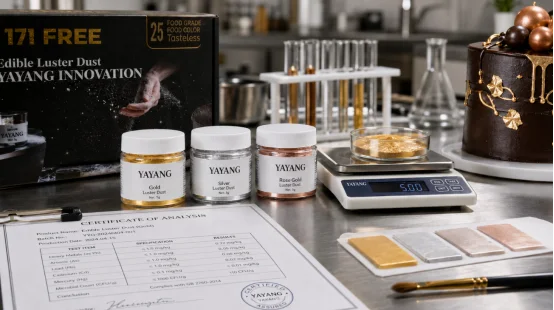
YAYANG’s product page describes its E171 free edible luster dust as food grade, common allergen-free, vegan and vegetarian, with no taste impact. It lists use on cakes, cookies, chocolate, beverages, and other baked goods. The powder can be applied dry or mixed with liquid for painting. Buyers should still request documents for the exact color and target market.
Check the Supplier’s Real Scope
An edible luster dust manufacturer may also be an edible pearl powder supplier or edible glitter supplier. Each product group still needs its own documents, including products from a food grade edible glitter manufacturer.
Which Product Documents Should You Review?
Paperwork should match the sample, invoice, label, and bulk shipment. A polished PDF with no batch number is not enough.
Compare the COA and Specification Sheet
An edible luster dust COA should identify the product, lot number, test date, specification limits, and actual test results. A certificate of analysis reports a batch result. A product specification sheet sets the normal product standard.
Ask for an edible luster dust COA before bulk approval and match its batch to the goods. A safety data sheet supports handling, but it does not replace food compliance records.
Request Allergen and Dietary Statements
Ask for a current allergen statement, vegan statement, and cross-contact details. Check which allergens are covered, especially for private label edible luster dust.
Which Tests Matter for Edible Luster Dust?
Edible luster dust testing requirements depend on the formula, use, and market. Do not ask only, “Is it tested?” Ask what was tested, when, by which method, and for which color.
Review Microbiological and Heavy Metal Testing
Discuss microbiological testing such as total plate count, yeast and mold, and relevant pathogens. Heavy metal testing may cover lead, arsenic, cadmium, and mercury. The report should show the product name, method, result, unit, date, and laboratory.
A third-party laboratory report adds confidence, while in-house checks control routine production. YAYANG states that it has a dedicated QC department, checks incoming materials, follows quality control through production, and tests batches. Its factory information also describes an ISO 9001 quality management system.
Check Batch Traceability
Ask whether finished goods can be traced to raw materials, production records, tests, and packing details. Also ask about retained samples and complaints. Six months later, a batch code beats a nice email.
How Can You Control Color Matching and Batch Consistency?
Color matching should happen on your real application. A metallic finish changes with particle size, base color, coating thickness, and light. A phone photo rarely tells the full story.
Approve Edible Luster Dust Samples
Test edible luster dust samples on the product you sell. A champagne gold may look soft on white fondant but stronger on dark chocolate. Beverage testing should also check dispersion, settling, and shake-back behavior.
For custom edible luster dust, give the custom color edible luster dust manufacturer a physical reference. Record the application method and approve a coded master sample for batch color consistency.
Check Shelf Life and Packaging
Confirm shelf life, storage conditions, moisture protection, batch coding, and packaging compatibility. Test the packaging seal and tamper-evident seal. Tiny jars create surprisingly large messes when powder leaks across a carton.
How Should You Compare MOQ and Landed Cost?
MOQ is rarely one number. Powder, printed jars, labels, and cartons may each have a different minimum.
Break Down the Minimum Order Quantity
Request the minimum order quantity for each color, formula, jar, label, and carton. An edible luster dust manufacturer with low MOQ should state whether it applies to standard or custom products.
If you need wholesale edible luster dust for cake decorating, confirm sample cost, production lead time, and reorder MOQ. Buyers seeking a bulk edible luster dust supplier should also ask about bulk pack sizes and repacking conditions.
Compare the Full Cost
Landed cost may include powder, jars, labels, testing, cartons, freight, duties, inspection, and local repacking. The cheapest bulk edible luster dust can cost more once these items are added.
What Should Private Label Support Include?
An edible luster dust supplier with private label should help move an approved powder into a sellable pack. That means more than placing a logo on a jar.
Confirm Packaging and Artwork
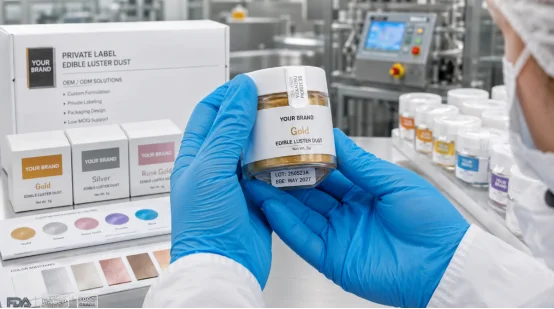
Edible luster dust private label packaging may include jars, bags, labels, barcodes, lot codes, expiry printing, and cartons. Clarify who supplies the ingredient text and who approves market-specific claims.
YAYANG’s OEM and ODM information describes custom colors, packaging, exclusive labels, sample confirmation by photos or video, support for large or small orders, and negotiable MOQ. It also states more than 20 years of effect pigment experience.
What Capabilities Support a Stable Supply Partnership?
Once ingredients, testing, samples, and cost are clear, wider support matters. YAYANG offers food, cosmetic, and industrial effect pigment categories, plus color customization, packaging, label design, and visual content services. Its E171 free edible luster dust is positioned for cakes, cookies, chocolate, and drinks.
This mix can suit importers, distributors, and private label buyers seeking one contact for product and pack development. Each order still needs approval against its formula, documents, sample, MOQ, and destination market. Clear records matter more than glossy color cards.
FAQ
Q1: How Do You Choose an Edible Luster Dust Supplier?
A: Check the complete ingredient list, market fit, batch COA, testing, color consistency, packaging, MOQ, traceability, and private label support.
Q2: What Documents Should an Edible Luster Dust Manufacturer Provide?
A: Request the product specification sheet, certificate of analysis, ingredient list, allergen statement, dietary statements, and safety data sheet when applicable.
Q3: What Should You Test Before Ordering Bulk Edible Luster Dust?
A: Test color, shine, application, odor, taste impact, dispersion, packaging seal, and batch documentation.
Q4: Can a Supplier Make Private Label Edible Luster Dust?
A: Yes. Confirm color development, edible luster dust private label packaging, artwork approval, coding, MOQ, and production lead time.
Q5: What Is the MOQ for Wholesale Edible Luster Dust?
A: It varies by color, formula, packaging size, label, and carton. Ask for the MOQ per color and each packaging component.