A pen that glides across dry royal icing may drag on fondant, crack a macaron shell, or leave a wet patch on wafer paper. The ink is only part of the result. Surface moisture, tip shape, hand pressure, and drying time decide whether your line stays clean.
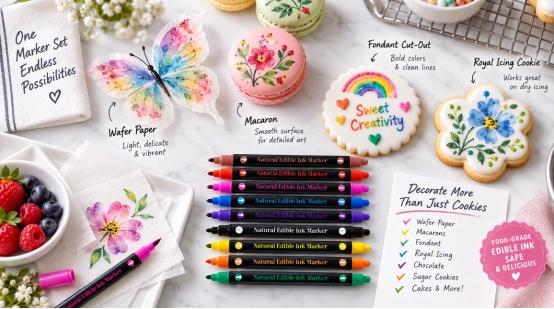
This guide shows you how to write on macarons and decorate fondant, hard icing, chocolate plaques, and wafer paper with practical edible art tools. A YAYANG Natural Edible Ink Marker has a fine tip for outlines and a broad tip for filling. Browse the wider food decoration range when planning a kit.
Why Does One Marker Behave Differently on Each Surface?
Every decorating surface has its own mix of firmness, fat, sugar, and moisture. Your first job is simple: let the surface reach the right condition before the tip touches it.
Match Pressure to Surface Strength
Use the weight of the marker on fragile shells and wafer paper. Add slight finger pressure on firm fondant or dry icing. If the tip leaves a dent, hold the barrel farther back.
Test Ink Flow Before Each Batch
Make three short strokes on a spare piece of the same material. Check line width, color density, and drying time. This test also removes excess ink from a primed tip.
How Should You Use Food Markers for Fondant?
Fondant gives you a smooth drawing area, though a warm or freshly rolled sheet can pull at the nib. Let the covered cake or topper firm until the surface feels dry and holds its shape under a light touch.
Draw Fine Details First
Use the fine tip for names, facial features, stems, and outlines. Hold it at roughly 45 degrees. Rest your wrist on a clean support beside the cake so your palm stays clear of the fondant.
Fill Color in Thin Passes
Turn to the broad tip for petals, blocks, and larger lettering. Apply one light pass, let it settle, then add another. Repeated rubbing in one wet spot can soften the sugar surface and make food markers for fondant feel sticky.
How Do You Write on Macarons and Protect the Shell?
Macarons need the lightest hand in the group. Their shells are crisp and curved, so support matters as much as pen control. Decorate filled macarons after they have rested and the outer shell feels dry.
Support the Shell From Below
Place the macaron in a shallow ring of folded paper towel or hold it around the filling line. Keep pressure away from the dome and let the fine tip skim the surface. This technique shows how to write on macarons while keeping the shell intact.
Build Letters With Short Strokes
Write each letter in two or three short movements. Long strokes follow the curve and may widen the line. For a monogram, mark tiny starting points, then connect them. Let the ink set before packing.
What Works Best on Royal Icing and Chocolate Plaques?
Both surfaces can take sharp artwork after preparation. Dry royal icing is porous and firm. Chocolate is smooth and contains fat.
Wait for Royal Icing to Dry Through
A soft layer below the crust can collapse under the nib. Let flooded icing dry fully, then outline with the fine tip and fill with the broad tip. A stencil keeps repeated logos or event dates consistent.
Bring Chocolate to a Cool Room Temperature
Condensation blocks clean ink contact. Let chilled plaques warm inside their closed container. Draw on a matte, dry face with one steady pass, then allow extra drying time.
How Can You Decorate Wafer Paper Without Wrinkles?
Wafer paper reacts quickly to liquid. A saturated nib can create a dark spot or make a thin sheet curl, so ink control comes first.
Remove Excess Ink From the Tip
Blot the marker on a spare wafer-paper strip. Use quick, light strokes and leave a gap between fresh lines. The fine tip suits veins, eyes, and lettering. The broad tip suits small filled areas.
Keep the Sheet Flat While It Dries
Place the paper on a clean silicone mat or dry acrylic board. Work from the center outward. If an edge lifts, pause and let the first marks dry. A little patience here saves a curled sheet.
Which Dual-Tip Technique Saves the Most Time?
A dual-tip edible marker works best when each end has one job. Plan the design first, especially when several dozen pieces need to match.
Outline, Rest, Then Fill
Sketch the boundary with the fine tip. Let it dry, then use the broad tip inside the shape. This sequence keeps edges readable and limits repeat passes.
Use a Simple Production Order
Decorate in this order: hard icing, firm fondant, chocolate, macarons, then wafer paper. Close each end promptly. The YAYANG website provides a route for current product and packing questions.
A Practical Marker Choice for Mixed-Surface Decorating
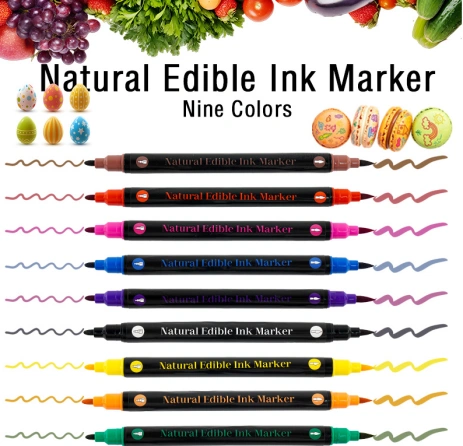
For a mixed-surface workflow, useful specifications include two stroke widths and food-use product information. The YAYANG Natural Edible Ink Marker pairs a fine tip for names and outlines with a broad tip for compact fill areas. The two tips suit fondant toppers, cookie details, macaron lettering, and wafer-paper accents.
For wholesale planning, use the food product category to start an inquiry. Send your colors, pack format, labeling needs, target market, and order volume. Request ingredient details, shelf life, storage guidance, samples, and the applicable MOQ. Test the sample on your recipes before approving a larger run.
FAQ
Q1: Can You Use the Same Edible Marker on Fondant and Macarons?
A: Yes. Test each surface first, use light pressure on macarons, and let fondant firm before drawing. A dual-tip format gives you separate tools for outlining and filling.
Q2: How Do You Stop an Edible Pen From Dragging on Fondant?
A: Let the fondant dry slightly, wipe away loose starch, and hold the pen at an angle. Thin passes help food markers for fondant move across the surface with less friction.
Q3: What Is the Safest Method for How to Write on Macarons?
A: Support the shell near the filling line, use the fine tip, and build letters with short strokes. Let the writing dry before the macarons touch packaging.
Q4: Can an Edible Ink Marker Be Used on Wafer Paper?
A: Yes, after a scrap test. Blot the nib first, draw quickly, and keep wet strokes apart so the paper stays flat.
Q5: What Should a Wholesale Buyer Confirm Before Ordering?
A: Request the color list, tip format, ingredients, allergen information, shelf life, storage guidance, samples, packaging choices, labeling options, and MOQ. Include the surfaces you plan to decorate when asking about the YAYANG Natural Edible Ink Marker and related edible art tools.